
Market Update | December 2025
Every month, we share the most important developments in the energy market. We explain how energy prices are determined, highlight trends over several months and years, and provide insight into how the market affects your energy bill.
December: Fossil fuel power plants drive prices
December generally saw mild winter weather, with above-average temperatures and sunny conditions. Only during the last week of the year were temperatures below average. Winds were stronger than in November, leading to a slight increase in wind energy production.
Despite these circumstances, fossil fuel power plants were the primary drivers of energy prices. The result: high average prices and limited price variations compared to the rest of the year. Volatility was low. Consequently, there was less opportunity for flexible assets, such as batteries, to capitalize on price fluctuations. This may have led to a downturn in December.
The day-ahead market
Prices on the day-ahead market were similar to those in November. Due to the shorter days, solar power generation was limited. Although wind power generation increased slightly, renewable generation was insufficient to meet demand. A large portion of the energy demand was met by fossil fuel power plants. This resulted in a high average price and small daily price fluctuations.
Spot market prices
Prices were slightly lower than in November, but remained high on average compared to the rest of the year. Conventional power plants, such as gas- and coal-fired plants, played a key role and supplied a large portion of the electricity. Because these plants generate electricity at a stable price, there was little volatility in the day-ahead market.
The first three weeks of December were exceptionally mild. It wasn’t until the last week, between Christmas and New Year’s Eve, that temperatures dropped. As a result, from December 26 through 29, prices remained stable and high at around €100/MWh, with little price fluctuation.
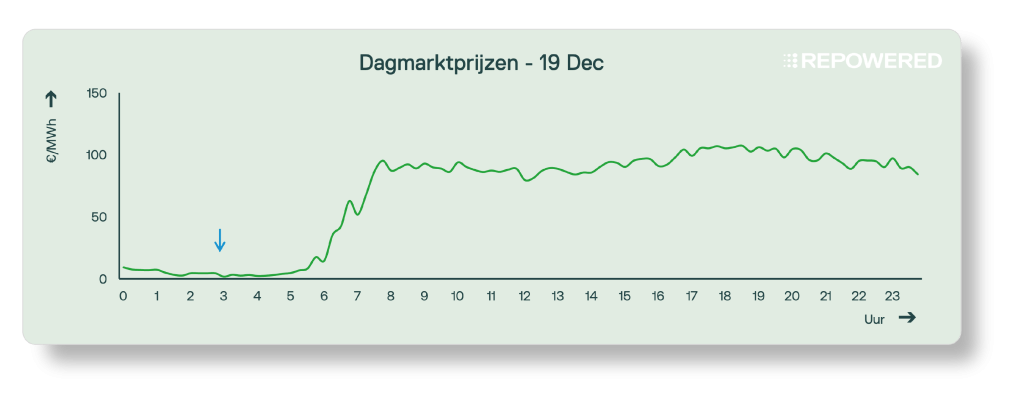
In addition, there were several days on which wind power had a clear impact. This is clearly visible in the graph below showing the day-ahead market prices for December 19. During the night of December 18–19, there was relatively strong wind. Combined with low electricity demand, this led to very low prices overnight, ranging from €1 to €10/MWh.
No negative prices in December
Despite periods of low demand and high wind power generation, there were no 15-minute intervals with negative prices in December. This is consistent with the trend observed in recent months and years.
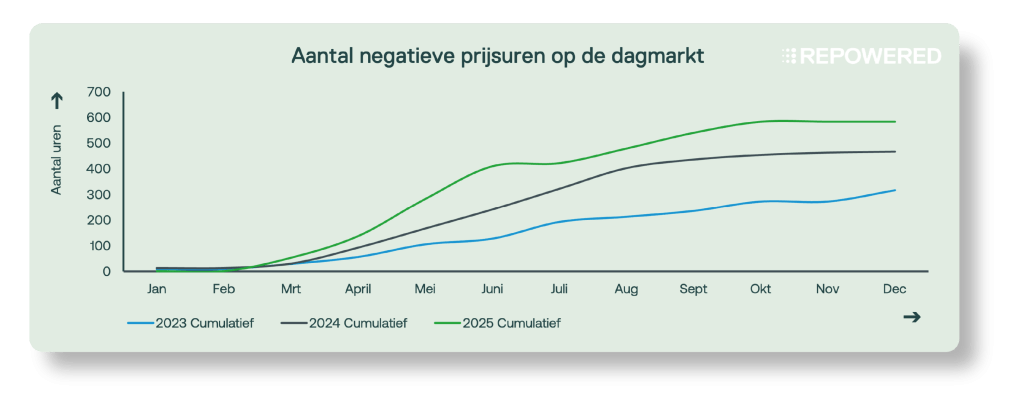
Even though the day-ahead market has switched to quarter-hourly intervals, we continue to count in hours for convenience rather than quarter-hours.
Highest price of the month: December 3
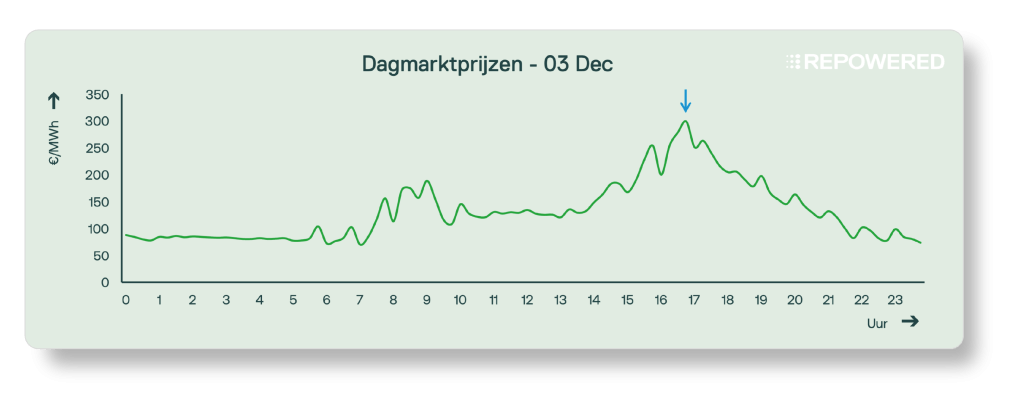
On December 3, the price of electricity reached its highest level of the month. Just as in November, this occurred on a Wednesday around 4:45 p.m. Starting at 2:00 p.m., the price rose rapidly to €299/MWh. We also saw similar price increases on December 12 and 16.
These spikes are caused by a combination of rising demand, a decline in renewable energy production, and the high startup costs of fossil fuel power plants. As a result, energy prices can rise sharply at such times.
The imbalance market
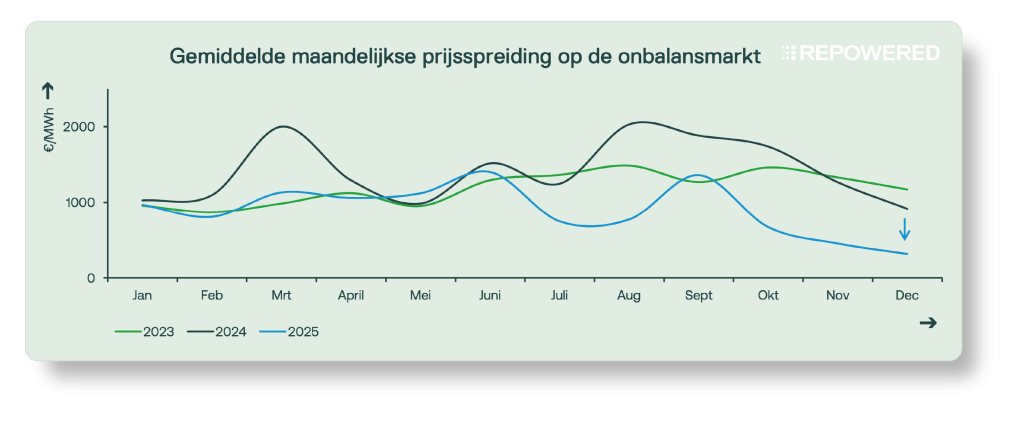
Volatility in the imbalance market remained extremely low in December, even lower than in November. The price spread was already at a historic low in November, but fell even further this month. The balancing system operated efficiently and stably. Thanks to sufficient flexibility, particularly from gas-fired power plants and wind energy, there were virtually no moments of imbalance in the system.
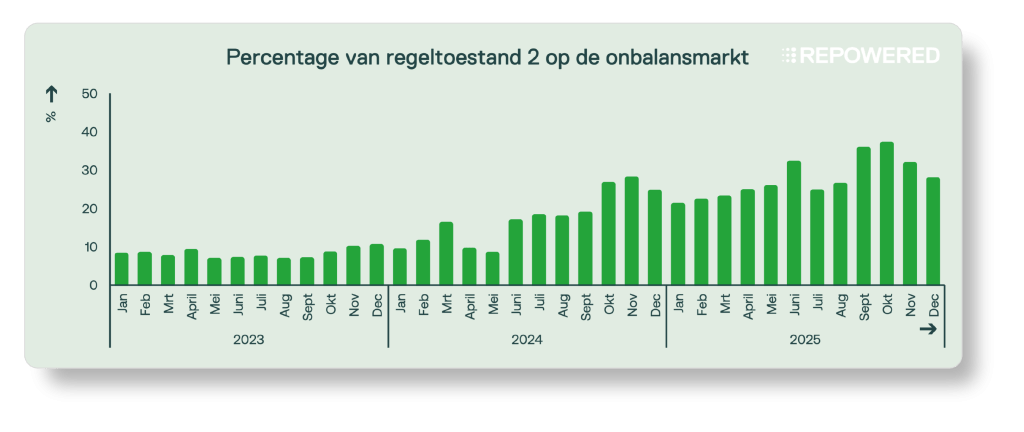
The number of quarters with control state 2 decreased slightly compared to last month, but remains extremely high: 27% of the imbalance quarters. Due to the combination of extremely low volatility and a high proportion of quarters with control state 2, it is currently hardly worthwhile for flexible assets, such as batteries, to contribute to system balancing.
Extremely low volatility
In December, the balancing system operated with exceptional efficiency: imbalance prices remained very low throughout the month. The system had sufficient flexibility, thanks in large part to conventional gas-fired power plants. For flexible assets, such as batteries, this presented few opportunities; revenues were significantly lower than in previous years.
Control Mode 2
In December, there were again an extremely high number of 15-minute periods with control state 2, though slightly fewer than in October and November. Regulation state 2 occurs when both a deficit and a surplus are present in the system during a single quarter-hour. In such a situation, TenneT charges the corresponding imbalance costs to all parties with an imbalance position. It is then not possible to contribute to balancing—for example, using a battery—and achieve a positive result.
The high number of quarter-hour periods with control state 2 increases the risk of passive balancing using a battery. To mitigate this risk and reduce imbalance costs, it is important not to respond to imbalance in an opportunistic manner. Charging or discharging should only occur when there is a clear deficit or surplus in a given quarter-hour period.
Just two brief price spikes: December 8 and 15
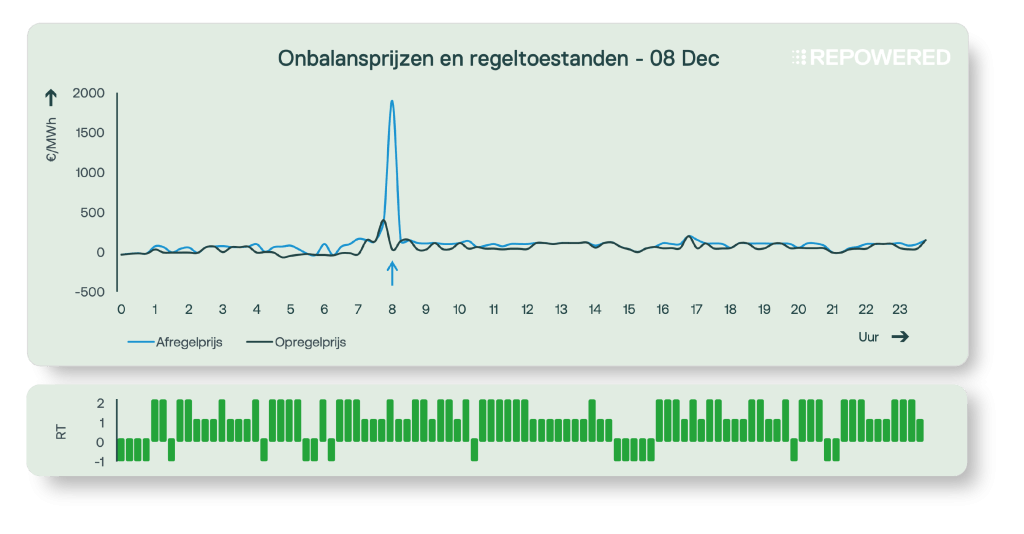
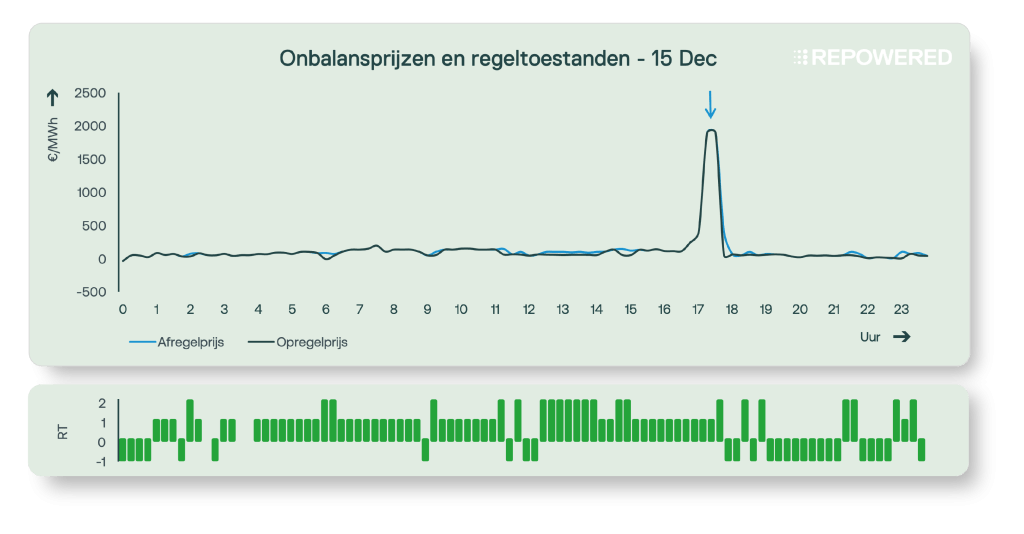
In December, there were only two instances of high imbalance prices: on December 8 and December 15. As shown in the graphs, the imbalance price reached €1,895/MWh at 8:00 a.m. on December 8 and reached the same level between 5:15 p.m. and 5:30 p.m. on December 15. This involved only three quarter-hours, with the quarter-hour on December 8 also ending in control state 2.
As a result, the earning potential for batteries, for example, was extremely low. Only on December 15 was there an opportunity to make a significant contribution and receive appropriate compensation for it.
Downward regulation price:The imbalance charge for downward regulation. When there is a surplus in the system, there is a price incentive to supply less or consume more.
When both a downward and an upward regulation price occur in a single 15-minute period, we refer to this as regulation state 2. In that 15-minute period, TenneT must perform both upward and downward regulation to keep the system in balance.
Feeling lost in technical jargon?
Don't worry! We've got a handy glossary ready for you👇