
Market Update | November 2025
Every month, we share the most important developments in the energy market. We explain how energy prices are determined, highlight trends over several months and years, and provide insight into how the market affects your energy bill.
November: Fossil fuel power plants drive prices
November marked the start of winter in the Dutch electricity market. Lower temperatures and shorter days led to an increase in electricity demand. At the same time, solar power generation fell by about 30% compared to October. Wind power generation remained roughly the same. With less renewable generation and higher demand, fossil fuel power plants (gas and coal) were used more frequently.
The result: higher average prices and smaller price differences. Volatility was therefore low. This makes it harder for flexible assets, such as batteries, to capitalize on price fluctuations and has led to a low number of cycles this month.
The day-ahead market
Day-ahead prices in November were significantly higher than in October. Due to lower solar energy output and stable wind power generation, there was insufficient renewable energy production to meet the increased demand. Fossil fuel power plants had to step in more often, resulting in higher average prices and narrower price differentials.
Spot market prices
Prices rose and remained high throughout November. Conventional power plants (gas and coal) played a key role and, with the exception of a few days with strong winds, supplied the majority of the electricity. Because these plants generate electricity at a stable price, there was little volatility in the day-ahead market.
Temperatures dropped across Europe in the final weeks of the month. Demand for electricity rose sharply, particularly on weekday evenings, leading to high prices . At the same time, our neighboring countries also had limited supply from renewable sources. As a result, the Netherlands exported a relatively large amount of electricity. These factors led to high prices on November 24, 25, and 26.
This is clearly shown in the graph below. We can see that average prices have risen compared to previous months (green line), while the daily price range narrowed compared to October (dotted line). Toward the end of the month, the price range widened due to high evening prices.
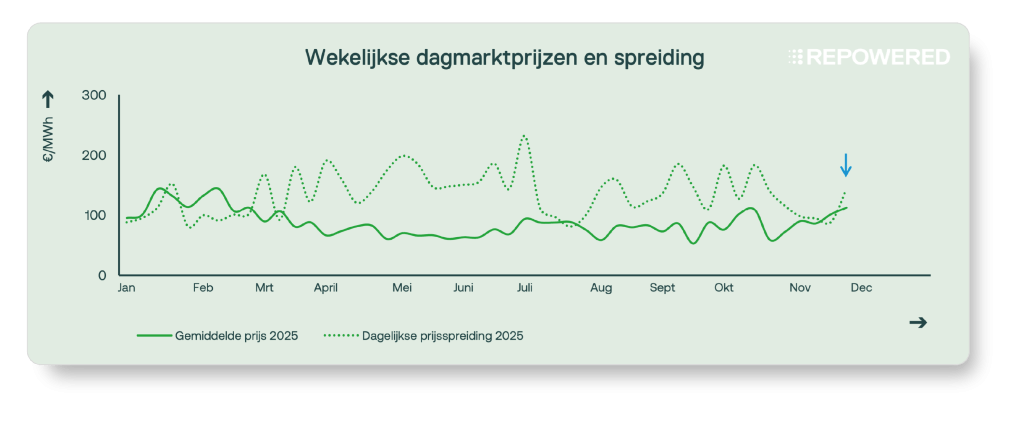
Theaverage daily price spreadis the difference between the highest and lowest quarter-hourly price on a single day. When the spread is large, the earning potential of batteries is high, because electricity can then be purchased cheaply (charging) and sold at a premium (discharging).
No negative prices in November
There were no periods with negative prices in November, which is typical for this time of year. During this period, negative prices can only occur when there is a high level of wind power generation and demand is low, such as at night or on weekends. This month, however, such periods did not result in negative prices.
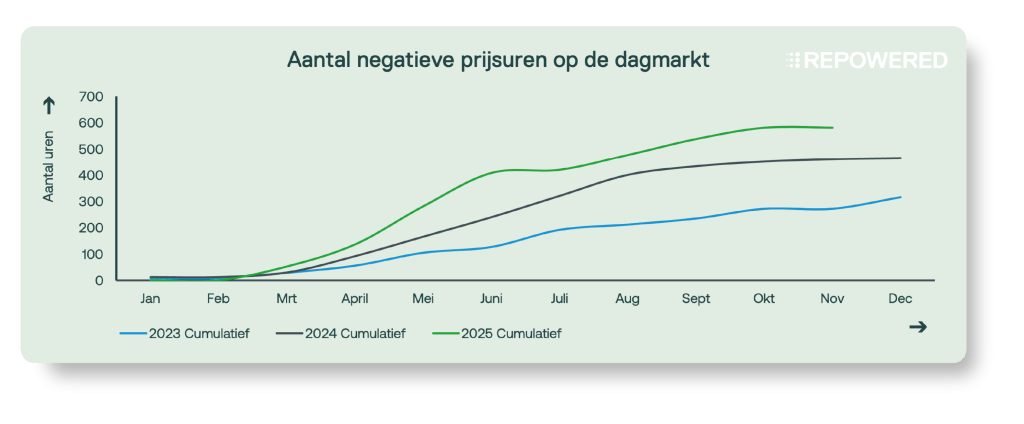
Even though the day-ahead market has switched to quarter-hourly intervals, we continue to count in hours for convenience rather than quarter-hours.
Highest price of the month: November 26
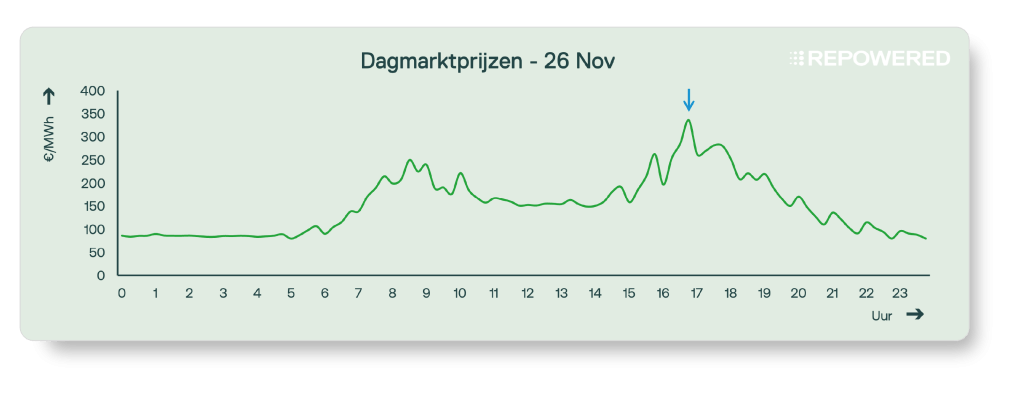
On November 26, electricity prices peaked at €335/MWh at 4:45 p.m. This was one of the few extreme price spikes this month. Wind generation declined as the day progressed, and solar power generation remained very limited. Gas-fired power plants had to ramp up, which drove prices high. At the same time, the Netherlands exported electricity to Germany and Belgium. Together, these factors caused the price spike in the afternoon.
The imbalance market
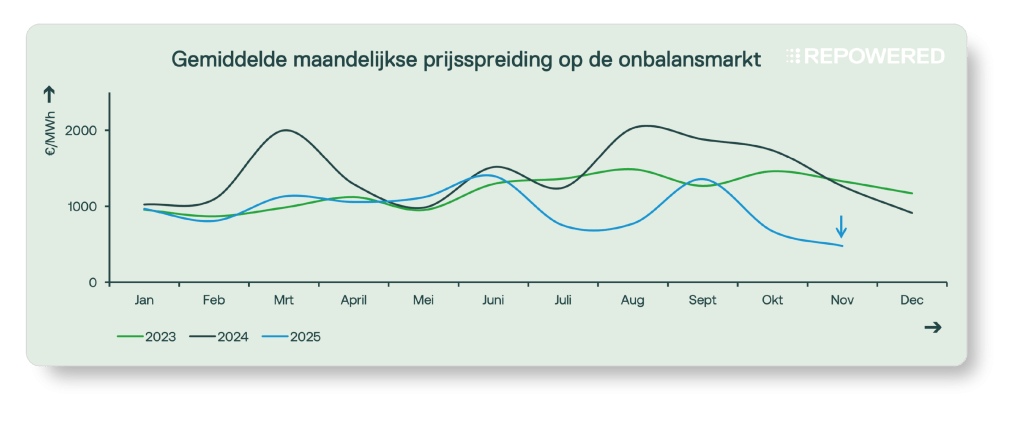
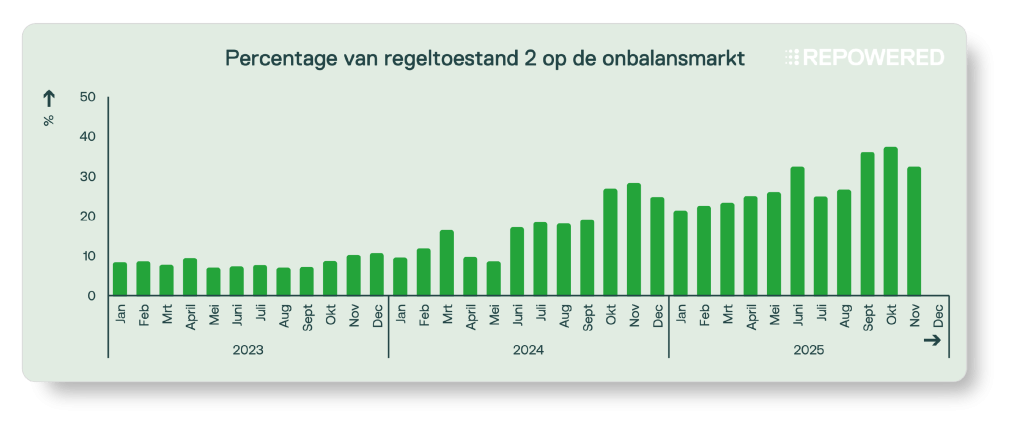
Volatility in the imbalance market was extremely low this month. The balancing system operated efficiently and stably. Thanks to sufficient flexibility, particularly from gas-fired power plants and wind energy, there were hardly any moments of imbalance in the system. At the same time, the number of quarters with control state 2 remained very high. This combination made it difficult for a battery, for example, to contribute to balancing the system.
Extremely low volatility
This month, the balancing system operated with exceptional efficiency: imbalance prices remained very low throughout the month. The system had sufficient flexibility, mainly thanks to conventional gas-fired power plants. Despite the low temperatures in the second half of the month, the system remained stable, and there was always sufficient balancing energy from gas-fired power plants and wind turbines to quickly absorb fluctuations in the balance. For batteries, for example, this offered few opportunities: the potential returns were significantly lower than in previous years.
Control Mode 2
Once again, there were an extremely high number of 15-minute periods with control state 2, though slightly fewer than last month. Regulation status 2 occurs when both a deficit and a surplus are present in the system during a single quarter-hour. In that case, TenneT charges the relevant imbalance costs to all parties with an imbalance position. It is then not possible to contribute to balancing—for example, using a battery—and achieve a positive result.
The high number of quarter-hour periods with control state 2 therefore increases the risk of passive balancing using a battery. To mitigate this risk and reduce imbalance costs, it is important not to respond too opportunistically to imbalance. Charging or discharging should only occur when there is a clear deficit or surplus in a given quarter-hour period.
TenneT remains dissatisfied with the high number of fluctuations in the system balance. For this reason, starting this month, TenneT has been publishing the balance delta every 12 seconds instead of once a minute. So far, this change has had little effect.
Day with an extreme number of regulatory situations 2: November 22
On November 22, more than half of all quarter-hour periods ended in control state 2. Winds were strong, and solar power generation was limited. Due to unstable winds and difficult-to-predict solar power generation, the balancing requirement fluctuated throughout the day.
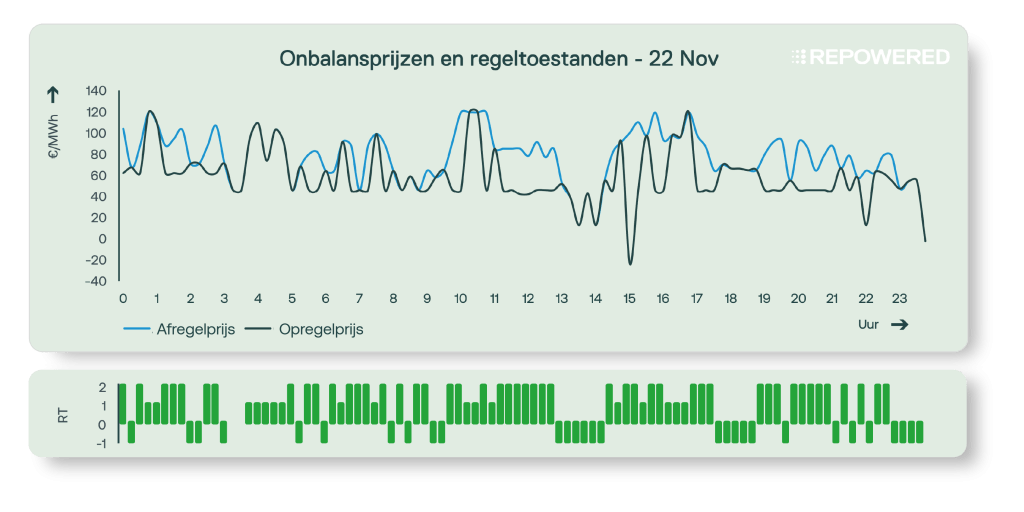
Downward regulation price:The imbalance charge for downward regulation. When there is a surplus in the system, there is a price incentive to supply less or consume more.
When both a downward and an upward regulation price occur in a single 15-minute period, we refer to this as regulation state 2. In that 15-minute period, TenneT must perform both upward and downward regulation to keep the system in balance.
Feeling lost in technical jargon?
Don't worry! We've got a handy glossary ready for you👇