
The merit order
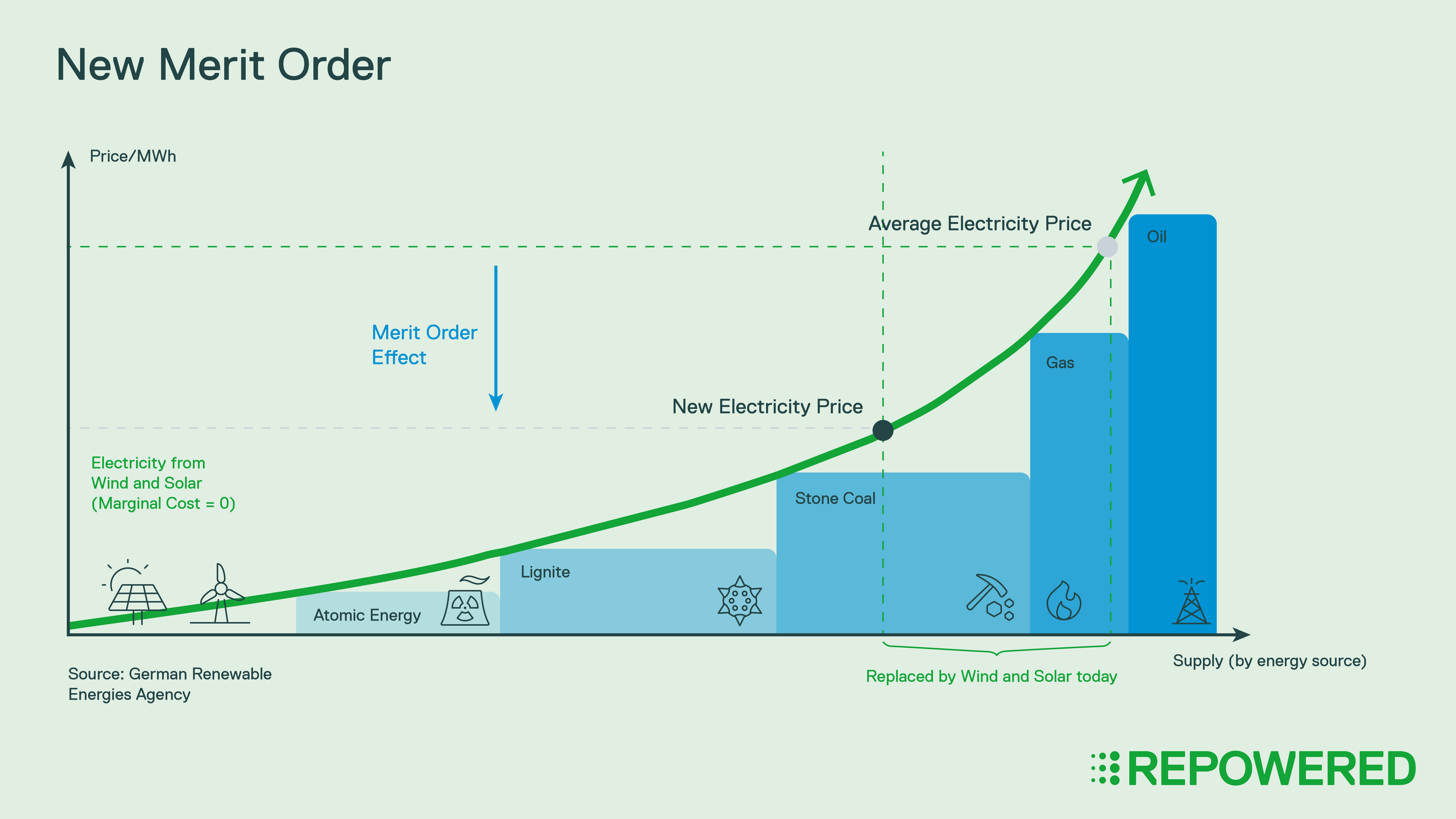
In the Netherlands, electricity trading takes place on exchanges, such as the futures, day-ahead, and intraday markets. Bids are continuously matched based on price, or on an hourly basis, as in the day-ahead market. This is done according to the so-called merit order principle, whereby the order in which different energy sources are deployed is determined based on their marginal cost. The markets for reserve capacity also use such a merit order.
The merit order method is used to determine the market volume and corresponding price of a specific energy product. The merit order principle assumes that an electricity producer will only generate electricity if the revenue per unit of electricity exceeds its variable costs for electricity. In the day-ahead market, this is how the volume and price per quarter-hour for the following day are determined. To do this, the market operator creates a curve by aggregating the bids for production, with the supply ranked in ascending order of price. The result is a stepped curve, with the offered volume on the x-axis and the requested price on the y-axis. (see graph below)
Setting a price
Renewable energy sources—such as solar and wind power—have very low marginal costs. They therefore sit at the bottom of the merit order curve. The same applies to nuclear energy, which has relatively low OPEX (operating costs) and is typically found just above renewable energy on the merit order curve. Next come coal- and gas-fired power plants. When CO2 costs are not factored into the price, the operating costs of coal-fired power plants are lower than those of steam and gas turbines (CCGT plants), and they rank ahead of CCGT plants in the merit order.
The graph below shows an example of a merit order.
What factors influence the merit order?
When there are spikes in electricity demand, the settlement point lies to the right on the merit order curve, meaning prices are high. Think of cold winter days when expensive peak-load units running on diesel or gasoline must be brought online. On sunny, windy days with abundant supply, the transaction price will be low.
What else influences the merit order? On the day-ahead market, the curve looks different on weekends than on weekdays, but there are also seasonal fluctuations. Gas and coal prices also have a major impact. A general trend is that, due to the increase in renewable energy, the transaction price is falling and the more expensive energy supply ends up above the intersection point (in an unchanged demand curve). As a result, energy prices will drop during periods of high solar and wind production. On an annual basis, this also means that gas and coal-fired power plants are operating fewer and fewer hours.