Network congestion
Network congestion 1 min. read

A capacity-limiting contract. How does it work?


A capacity-limiting contract (CBC) specifies the amount of transmission capacity you are permitted to use at your connection point. The basic principle is that you always retain your existing capacity, but the grid operator may, in some cases, temporarily impose a restriction if the grid becomes congested. The terms can be flexible—for example, on an on-demand basis—or at fixed times; there are many options available.

For an on-call contract, for example, it looks like this:

  • No later than one day in advance, the grid operator will indicate whether congestion is expected and how much power cannot be temporarily supplied to or drawn from the connection.
  • The restriction never lasts longer than necessary and usually lasts only a few hours a day.
  • In return, compensation is provided: both for keeping the capacity available and for the actual restriction.
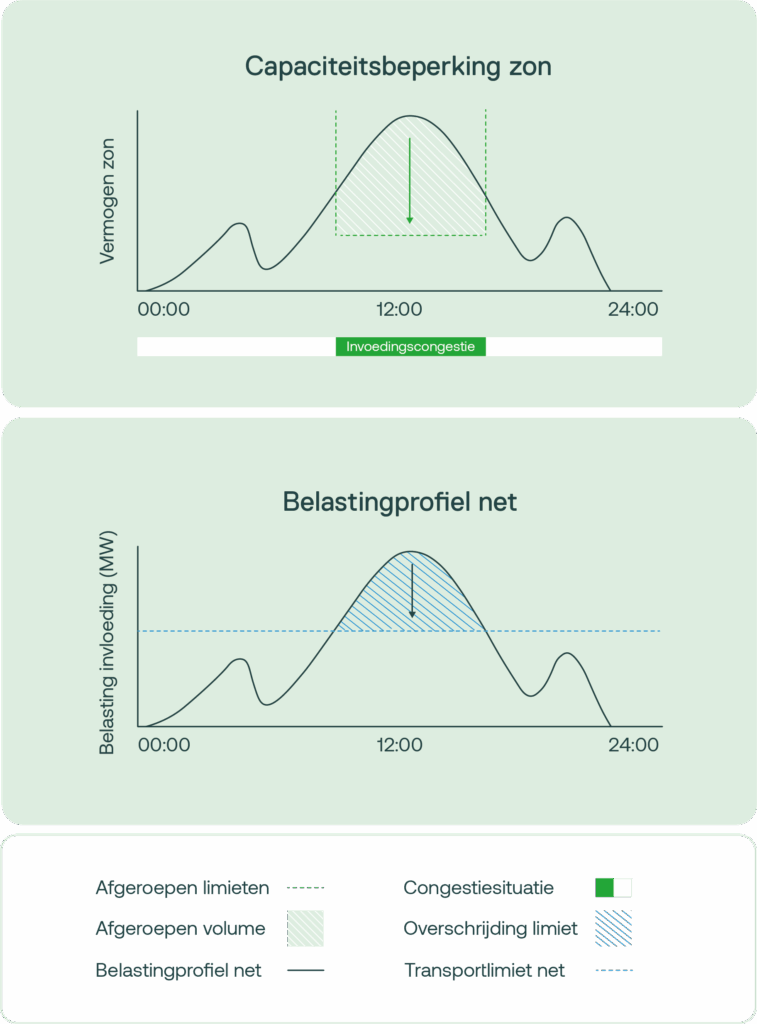
A capacity limitation of a solar farm with a CBC.
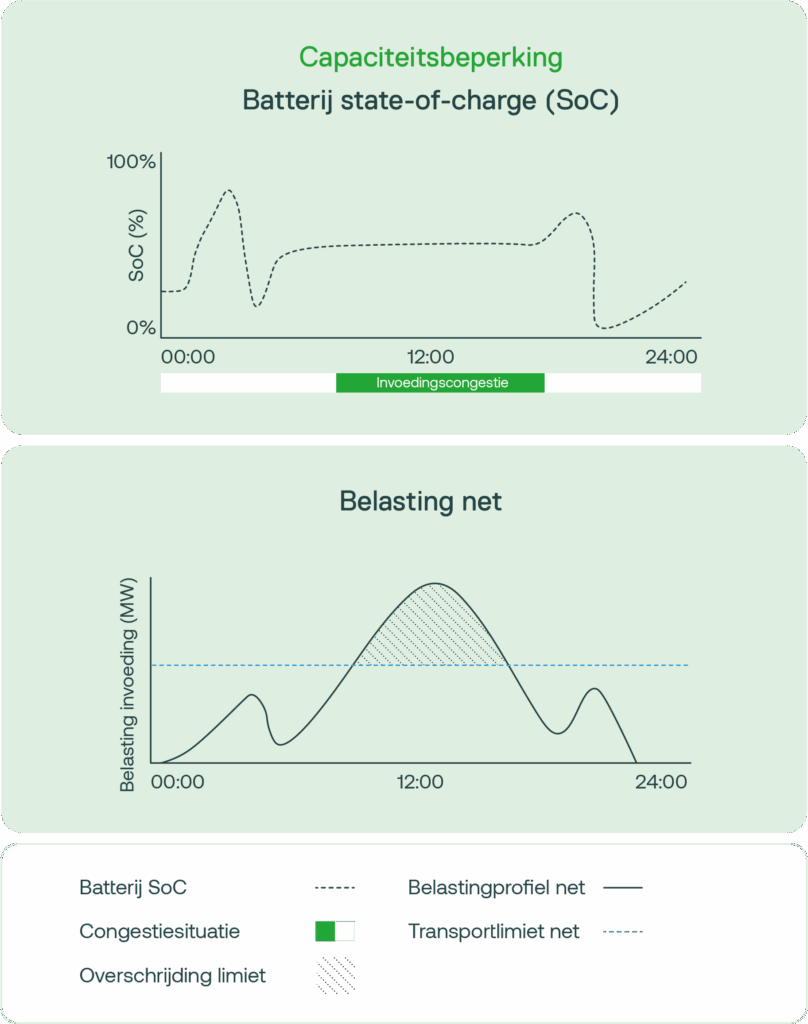
In the event of capacity constraints, we do not use the battery. This prevents congestion from worsening.
Share article
Network congestion 1 min. read
White Paper | A New Perspective on Batteries

We have written a white paper, in collaboration with APPM, in which we bring together the various interests and perspectives on large-scale battery projects.…

Network congestion 1 min. read
The difference between congestion-neutral and congestion-mitigating

Large-scale battery projects are increasingly required to operate in a congestion-neutral or even congestion-mitigating manner. This means that battery usage does not…

Network congestion 1 min. read
A capacity management contract. How does it work?

The Capacity Management Contract (CSC) is the successor to the CBC. However, the grid operator can still use both the CBC and this…

Go to the knowledge base