
Network congestion
Network congestion 1 min. read

A capacity management contract. How does it work?


The Capacity Management Contract (CSC) is the successor to the CBC. However, the grid operator can still enter into both the CBC and this new type of contract. Just as with the CBC, the grid operator will notify you the day before of what you need to do, or you can agree on specific times when action is required. The difference from the CBC is that with this contract, you can also actively manage your load rather than simply limiting it.

A good example is a battery: an agreement is made with the grid operator to charge the battery when there is excess generation in a congested area, or to discharge it when too much electricity is being drawn from the grid. With our smart control system, we ensure that the battery is fully charged at the right time and that you receive appropriate compensation from the grid operator.
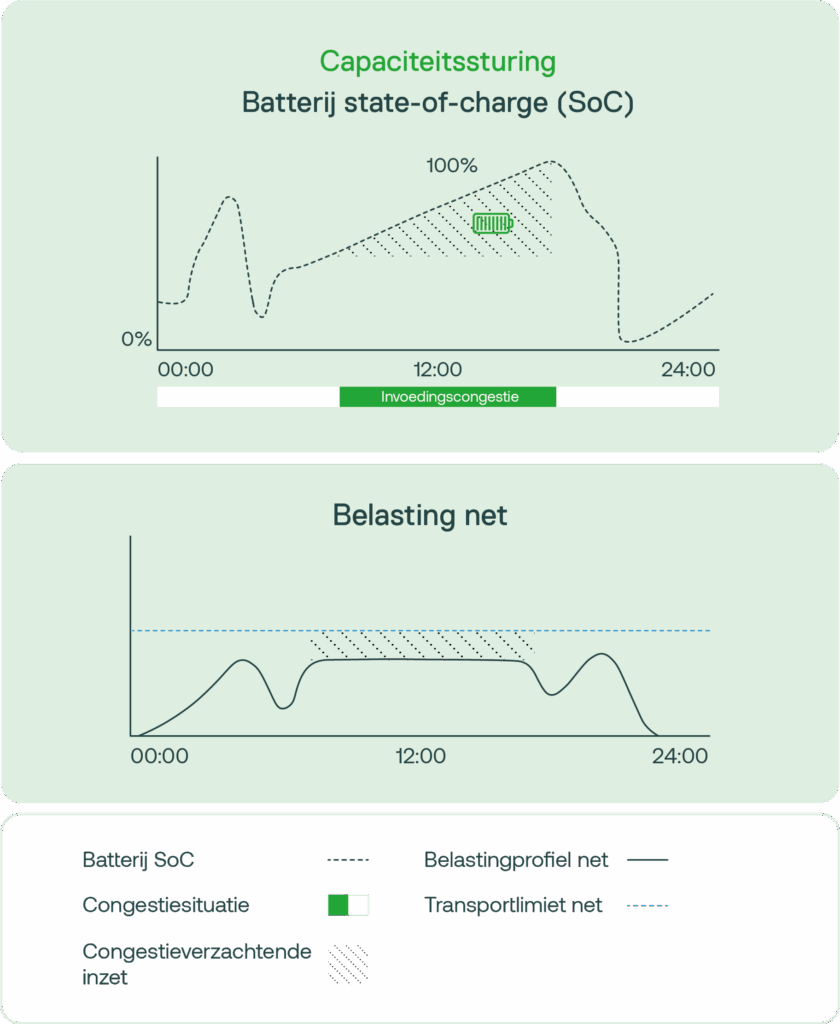
Capacity management means that we use the battery to alleviate congestion. When there is excess generation, we charge the battery.
Share article
Network congestion 1 min. read
White Paper | A New Perspective on Batteries

We have written a white paper, in collaboration with APPM, in which we bring together the various interests and perspectives on large-scale battery projects.…

Network congestion 1 min. read
The difference between congestion-neutral and congestion-mitigating

Large-scale battery projects are increasingly required to operate in a congestion-neutral or even congestion-mitigating manner. This means that battery usage does not…

Network congestion 1 min. read
A capacity-limiting contract. How does it work?

A capacity-limiting contract (CBC) specifies the amount of transmission capacity you are allowed to use at your connection point. The basic principle is that you…

Go to the knowledge base