
The difference between congestion-neutral and congestion-mitigating

Grid congestion means that the power grid has temporarily reached its maximum capacity. No additional transmission capacity is available at that time. This can limit local businesses and slow down sustainability initiatives.
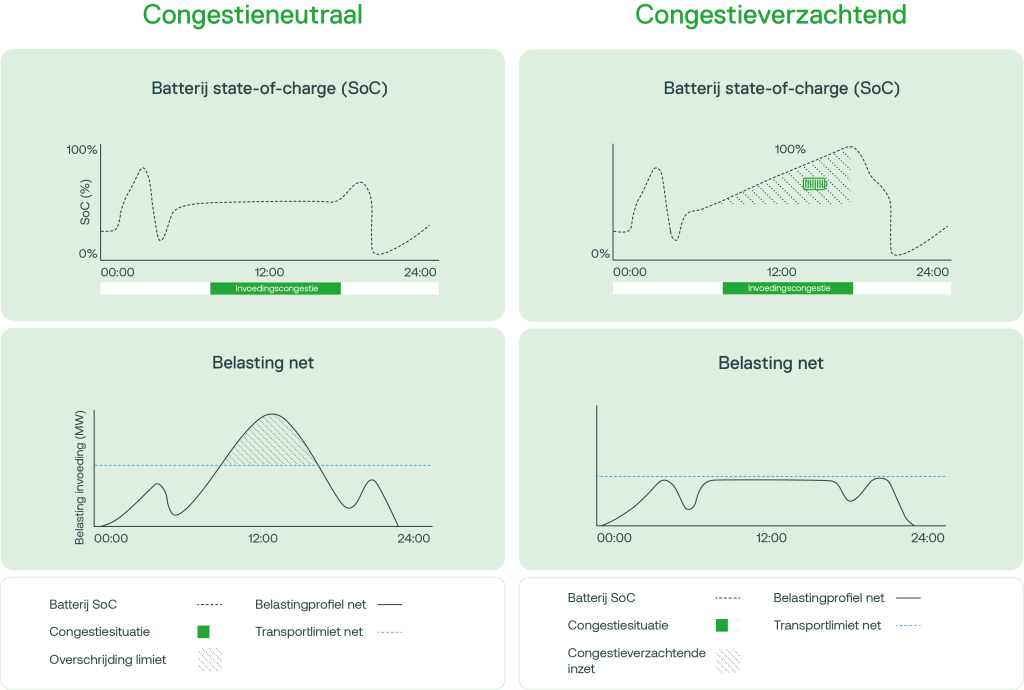
Battery storage can affect grid congestion in an area in various ways. Depending on how and when a battery is deployed, it can exacerbate grid load, have no effect, or actually help reduce congestion.
As a result, large-scale battery projects are increasingly required to operate in a congestion-neutral or even congestion-reducing manner. This means that battery usage does not place additional strain on the grid during peak periods, and ideally helps to relieve the load on the grid.
What exactly does this mean?
Congestion-neutral
A battery is considered congestion-neutral if its charging and discharging schedule does not exacerbate the congestion situation:
- The battery does not draw power during load congestion
- The battery does not supply power during feed-in congestion
: Congestion-reducingA battery is considered congestion-reducing when its charging and discharging schedule actively helps to reduce congestion:
- The battery draws power during grid congestion
- The battery supplies power during demand congestion
Example
Why is this important?
The distinction between congestion-neutral and congestion-mitigating behavior is particularly relevant when a permitting authority imposes specific requirements on a project. In practice, these terms are sometimes interpreted differently, which makes it difficult to formulate clear policies. As a result, it is often unclear to battery project developers exactly what is expected of them.
Measures for congestion-neutral and congestion-mitigating deployment
Both of these issues can be addressed through physical and contractual measures that ensure a battery is used properly.
Congestion-neutral
A battery can be used in a congestion-neutral manner by limiting its connection during periods of congestion:
- Time-Limited Transmission Rights (TDTR):TenneT may restrict the connection for up to 15% of the time.
- Capacity Reduction Agreement (CRA):The member voluntarily agrees to reduce transmission capacity during peak periods.
for Congestion Relief A battery can actively support the grid by reducing congestion:
- Redispatch with mandatory bidding:The connected party offers flexibility per bidding round via the GOPACS platform.
- Capacity Management Contract (CSC):The grid operator may request capacity one day in advance for additional feed-in or off-take in exchange for a pre-agreed fee.
By formalizing these agreements, the grid operator can prevent battery deployment from exacerbating congestion and, where possible, actually help reduce it. In addition to these congestion management measures, a battery can also be used for other purposes, such as balancing services or participating in energy trading.
“By supporting both policymakers and developers, we can actively help clarify complex concepts related to congestion. In this way, we build a bridge between policy and practice, enabling both sides to better understand each other and collaborate more effectively.”

How Repowered Can Help
Support in developing BESS policies that include clear definitions of the above terms and applications of battery deployment (for provinces/municipalities).
Guidance for battery developers on grid-supporting deployment and qualification, tailored to local policies.
We are a Congestion Service Provider; we handle arrangements with the grid operator on your behalf and make smart use of your flexible capacity.